
Transparent methodology · version 2.1
How person ratings work
Follow the evidence. Understand the interpretation. See how the record changes.
Our assessments describe documented statements and conduct. They do not determine a person’s spiritual standing. Facts, biblical interpretation and reporting analysis remain separate.

Layer 1 · Factual record
Sources become a record—not assumptions
Only a person’s own assertions or explicit endorsements count. Reporting a quotation, appearing in a story or belonging to an organization never transfers a rating.
We use the latest published check for each distinct attributable claim with validated source evidence. Verified = 100; mostly supported = 80; misleading or missing context = 25; false = 0. Their unweighted mean becomes the score. Disputed, unsupported, unverifiable and opinion claims are excluded and counted separately.
At least five eligible claims across three events are required. A = 80–100; B = 65–79.9; C = 50–64.9; D = below 50. An unrated record never means false.

Layer 2 · Biblical perspective
Scripture, with context and limits
Each assessment addresses a specific sourced action or statement. It includes cited Scripture, reasoning and interpretive limitations.
An aggregate requires five qualifying assessments across three events. Conflicting classifications produce Mixed. Uncertain assessments do not count toward the minimum. An event’s label is never automatically assigned to everyone mentioned.
Identity · History · Reassessment
One person, a developing record
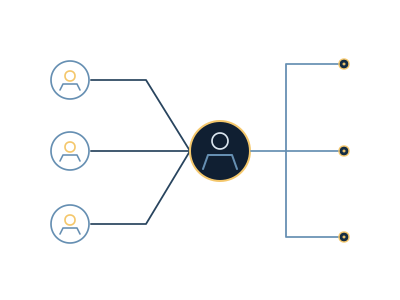
Corroborated aliases link to one canonical profile. Names alone never establish identity: source context, public identifiers and documented affiliations help distinguish namesakes and historical figures.
Research starts with recent coverage and expands gradually in small hourly batches. New evidence can produce a new assessment version. Previous versions and citations remain part of the record; failed retrieval never erases a published assessment.
Active records are revisited weekly, older records monthly, subject to source availability and the daily research budget. News and reader requests take priority. Weekly emails capture the evidence available when that edition was prepared; their analysis links lead to the current record.
Discovery without personal tracking
Trending and popular
Trending combines independent publisher coverage and qualified reads over 24 hours with read growth between six-hour windows. Its weight halves each day since the latest original coverage. Popular counts seven days of qualified reads.
A qualified read requires ten visible seconds and is counted once per document and anonymous daily visitor. Do Not Track and Global Privacy Control are honored. The read-count system stores no fingerprints or raw IP addresses; deduplication records expire after 48 hours.